%20Logo%20Transparent%20Light%20Text.png)
Is It Still Worth It to Put Part of Your Paycheck into a 401(k)? My Take
- Jose Alvarez, CFP®, MBA

- Oct 18, 2025
- 9 min read
Updated: Oct 21, 2025
Follow The Vault & Forge on Spotify for a weekly markets, economy, and life podcast!
Why This Question Comes Up So Often
I hear versions of this question all the time from folks who are working hard, building careers, and trying to make smart money decisions in real life, not in a textbook.
Recently I came across a social media post were the author said they make about 78,000 dollars a year in base pay, up to 85,000 dollars with bonuses. They contribute 8 percent to their 401(k), and someone advised them to go to 10 percent. Their company matches up to 7 percent. They wondered if the extra dollars might be “better” in other investments.
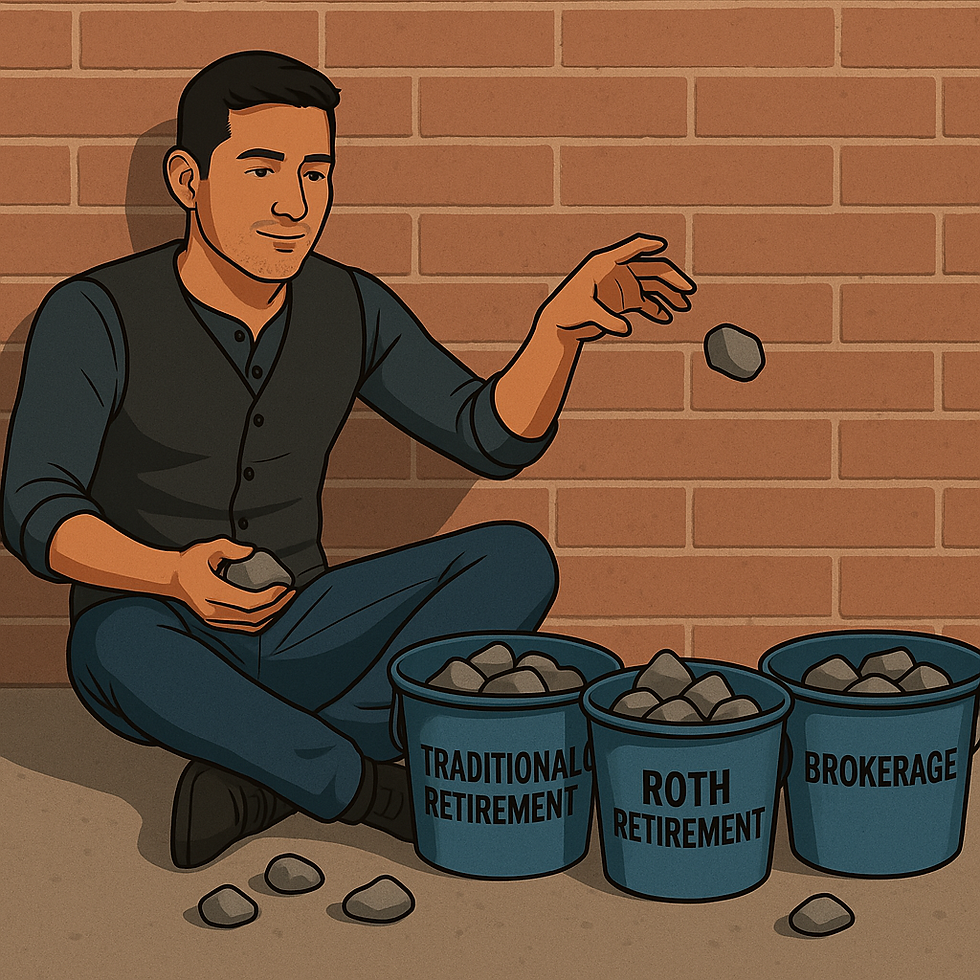
I get it. I have wrestled with the same trade-offs in my own life. I have set my own contributions to auto-increase over time, and I have intentionally split my savings between retirement accounts and a taxable brokerage account. I want my future to be funded, and I also want money that I can deploy for opportunities and experiences while I am still young enough to enjoy them.
If you've asked yourself a similar question, you are not alone.
The real issue is not 401(k) versus “other stuff.” The real issue is sequence and purpose.
First, you lock in the free returns. Second, you push your savings rate higher in a way you barely notice. Third, you decide how much flexibility you need in your life and aim part of your savings at that goal.
Start With the Highest-Return, Lowest-Risk Move: The Match
The employer match is part of your compensation. Treat it that way, and do not leave it on the table.
If your plan matches up to 7 percent, step one is to contribute at least 7 percent.
I know that sounds basic, but many people miss pieces of the match because they change jobs, forget to set a percentage on day one, or let a raise come and go without adjusting their deferrals. The match is as close to a guaranteed return as you will find in personal finance. Capture every penny, every paycheck, every year.
If you are already contributing 8 percent, and the match is 7 percent, you're clearing the first hurdle. Nice work.
The Automation Trick That Quietly Raises Your Savings Rate
Behavior beats tactics. If you automate good behavior, you'll win by default.
I am a big fan of auto-escalation. At one of my past employers, the plan auto-increased contributions by 1% each year until you hit 10%. You could also set it to continue climbing beyond 105. It was incredibly effective, because a 1% change is barely noticeable in take-home pay, yet over time it adds up in a meaningful way.
If you are at 8 percent today, setting your plan to increase by 1% per year could lead to some pretty dramatic benefits over time. In a few years you will be at 12%, and you will not have felt much pain getting there.
I have used this approach personally, and I still use it with clients, because it respects human nature. Nobody wakes up excited to manually update payroll deferrals.
Automation does it for you, quietly and consistently.
What 401(k) Menus Usually Look Like, and Why That Matters
Simpler menus are common. Participation and oversight drive those decisions more than anything else.
Most 401(k) menus are short. You will see a handful of target date funds, a broad U.S. equity fund, an international fund, a bond fund, and a cash or money market option. Plans keep menus tight for several practical reasons. Simpler menus can lead to higher participation, lower confusion, and a cleaner fiduciary process for the plan sponsor. If too many employees disengage or fail discrimination tests, the plan risks top-heavy problems, which is a headache for the employer and, indirectly, for you.
Target date funds are like one-size-fits-all shirt. They start aggressive when you are young, then they gradually get more conservative as you approach retirement. Will they work? Sure. Will they make you look good? Tough call. If a target date fund gets you invested and keeps you invested, I am okay with that. If you want more control, you can build with the core funds but as a DIY-er, it might be beneficial to keep it simple or under the advisement of your advisor.
Where “Better” Might Be True: Outside Accounts and Customization
Once the match is secured, extra dollars can flow to places that offer either better tax positioning or more flexibility for your life.
Traditional IRA and Roth IRA
If you want more investment choice than your 401(k) offers, an IRA gives you a much wider universe. You can build a low-cost, diversified portfolio with broad market funds, factor funds, sector funds, or individual stocks if you want to. The big choice here is tax treatment.
Traditional IRA contributions, if deductible for you, lower your taxable income now and grow tax deferred.
Roth IRA contributions are after-tax, but they grow tax free, and you do not owe tax on qualified withdrawals in retirement. Eligibility rules apply, so you need to make sure you qualify or consider legal routes like the backdoor Roth if appropriate. I like the Roth for younger savers who expect higher income later and value tax-free growth. I also like the simplicity. What you see is what you own. No future tax surprise if rates change. That said, every situation is unique, and a traditional IRA can still make sense for certain taxpayers who benefit from the deduction today.
Taxable Brokerage Account
If you hear me talk long enough, you will hear me say this. I love the flexibility of a taxable brokerage account. There is no early withdrawal penalty. You can invest in almost anything that fits your plan. You can harvest losses in bad markets to offset gains or income elsewhere, then reinvest and keep compounding. You do not get the clean tax treatment of a Roth, and you do have to plan around capital gains, interest, and dividends. Still, the liquidity and optionality are huge.
This is the account that lets you do real life. Want to take your spouse and kids to Greece for two weeks next summer and pay cash without guilt? That can come from the brokerage account. Want seed money to start a business when the right opportunity shows up? That can come from the brokerage account. Want to help a child with a first car or an education expense without dealing with 529 restrictions? Again, brokerage. It gives you choices, and choices have value.
A Simple Sequence I Like to Follow
There is no perfect formula for everyone, but there is a sensible order of operations that works in most cases.
Capture the full 401(k) match. That is the floor. I don't lose free pay.
Auto-escalate my 401(k) savings rate by 1 percent a year until I've reached my long-term target - often 12 to 15 percent of gross income, including the match.
Decide how much flexibility I want in my life over the next 3 to 10 years. If the answer is “a lot,” I'll channel extra dollars into a taxable brokerage account. If I'm more focused on retirement tax planning, push extra to a Roth IRA or, if available and appropriate, a Roth 401(k) source inside my plan.
If my plan offers a good Roth 401(k) and I'm in a relatively low tax bracket right now, defer to the Roth.
Once I have the retirement and brokerage pillars in place, add in purpose-built accounts as needed - like 529 plans for education, HSA if available for triple tax advantages, or a UTMA for a minor.
This is not about choosing a single best account. It is about assembling the right mix for real life, taxes, and goals.
What I Do Personally
I practice what I preach, and I adjust as my life changes.
I run my own contributions on autopilot. For a long stretch, I had 12 percent flowing to my 401(k) from every paycheck. On top of that, a fixed monthly dollar amount went to a taxable brokerage account. My wife’s retirement account received a set contribution, and my son’s UTMA received another.
When you add it all up, our household savings rate sits around 25 percent of income. The exact mix has changed over time, but the rule is the same: automate the future, then live the present with less guilt, less friction, and more intention.
I like knowing the boring stuff is handled so our mortgage, car, normal bills, retirement savings, and our kid’s bucket all happen on schedule. That frees me up to spend without second guessing every coffee or lunch.
I have already taken care of later, so I can enjoy now.

A Word on Guilt and Spending
If you automate a serious savings plan, you earn the right to spend without shame.
Too many people feel bad about normal life because money advice on the internet can be loud and rigid. I am not interested in shaming anyone. If you hit your savings targets, keep your plan in balance, and avoid debt traps, go have some experiences. Take your spouse on a trip. Play golf with a friend. Bring your kids to a game. Your memories are part of your return on investment, even if a spreadsheet cannot measure them.
This is where the brokerage account shines. It is the pressure valve that lets you participate in life without beating yourself up. It is not a tax shelter, but it is a freedom tool.
I would rather see a client saving at a strong rate and enjoying their life than deferring everything to an unknown retirement that might not look the way they imagine.
When “Other Investments” Actually Make Sense
Sometimes the best move is outside the 401(k), not because the 401(k) is bad, but because your goals require flexibility or specialization.
Here are a few cases where I often direct extra dollars away from the 401(k), after the match and basic targets are handled.
Entrepreneurial runway. If someone plans to start a business in the next few years, they'll likely need accessible capital. Build the brokerage balance first.
Big-ticket goals inside 5 years. House down payment, adoption costs, a sabbatical, or extended travel. The timeline is too short for retirement accounts to be useful.
Specialized investment approach. If someone wants to own individual stocks, factor tilts, or niche funds that their 401(k) does not offer, an IRA or brokerage account is the right tool.
Tax bracket management. If someone's in a lower bracket today than they expect in the future, Roth contributions can be powerful. If they sit in a high bracket right now and benefit from deductions, a traditional 401(k) or IRA may help. The point is to use the right tool for the current season of life.
None of this requires turning your back on the 401(k). It requires a plan that respects both today and tomorrow.
Portfolio Simplicity Beats Constant Tweaks
Most of the win comes from your savings rate, your time in the market, and your fees, not from chasing the perfect mix every quarter.
Inside the 401(k), a target date fund or a simple three-fund mix can help get started. In an IRA or brokerage account, you can add personalization, goals and needs-based investing, nuance if you enjoy it.
I care about costs, taxes, and behavior. Costs and taxes are math. Behavior is where most plans fail. Automate the behavior, and the math has a chance to work.
The Age Access Rules, Without the Jargon
Penalties are real, and they can be avoided with planning.
Retirement accounts are designed for retirement. In general, withdrawals before age 59.5 trigger a 10% penalty, plus taxes if the money is pre-tax. There are exceptions, especially inside 401(k)s for certain circumstances, but those are exceptions, not a plan. This is one reason I highlight the brokerage account so often. If you know there is a strong chance you will need money before age 59.5, I'd think twice before locking every dollar inside retirement accounts.
Final Thoughts: “Better” Is Personal
The 401(k) is not your enemy. It is a reliable workhorse.
The question is how to fit it into a larger life plan.
I have seen people thrive with a very straightforward approach - capture the match, automate the climb to a double-digit savings rate, then split the extra between retirement and a taxable brokerage account in a way that matches their life.
When you do that, you buy two things at once. You buy future freedom, and you buy present quality of life. I care about both - for my family and my clients.
If you want help dialing this in for your exact situation, that is what I do every day. We look at your income, benefits, household goals, and tax picture, then build a plan that you can stick to.
The right plan is the one that you will follow, and the best time to start is now.
Jose Alvarez, CFP®, MBA
Founding Advisor
Harvest Horizon Wealth Strategies
The information presented in this blog is the opinion of the author and does not reflect the views of any other person or entity unless specified. The author may hold positions in any securities discussed in this blog. The information provided is believed to be reliable and obtained from reliable sources, but no liability is accepted for inaccuracies. Images included in this blog are created by artificial intelligence. Any resemblance to any existing persons, past or present, is purely coincidental. The information provided is for informational, entertainment, and educational purposes and should not be construed as advice. Advisory services are offered through Harvest Horizon Wealth Strategies LLC, an investment adviser registered with the state of Wisconsin.


Comments