%20Logo%20Transparent%20Light%20Text.png)
I Don't Believe Income Tax Will Disappear
- Jose Alvarez, CFP®, MBA

- Jan 8
- 7 min read
Updated: Jan 13

I’ve been seeing this headline float around and I can’t ignore it because it hits right at the intersection of politics, money, and what I’ll loosely call reality.
The article comes from MoneyWise, and the headline says exactly what you think it says:
Trump says he may cut U.S. income tax 'completely' because tariff revenue will be 'so large'. But does the math actually add up?
According to the article, President Trump said:
“Over the next couple of years, I think we’ll substantially be cutting and maybe cutting it completely, but we’ll be cutting income tax. Could be almost completely cutting it because the money we’re taking in is going to be so large.”
If you stop right there, it sounds incredible.
No income tax??? If you're the president and you're trying to get attention, you can easily do it by saying you're going to get rid of one of the highest, if not THE highest annual household expense.
It’s simple (to say) ...
It's a bold problem to tackle...
It taps directly into something lots and lots and lots of people agree on:
Paying taxes sucks
But income tax isn’t just some rounding error for the federal government's budget. In fact, as you can probably guess when you look at your paycheck, it’s the largest single source of revenue the federal government has.
If you're an employee, they snatch that right out of your check. If you're self-employed, you're forced into the agony of writing that check yourself every few months.
But can this really happen? Eh... once you slow this conversation down and actually look at the numbers, the claim starts to unravel pretty quickly.
Why Income Tax Matters So Much
In 2025, the federal government collected approximately $2.7 TRILLION in individual income taxes. That represented about 50.7% of total federal receipts, which came in around $5.235 trillion.
Said differently... a shit ton of money.
For comparison, corporate income tax brought in roughly $452 billion and tariff revenue totaled about $195 billion, according to MoneyWise, while other sources place tariff revenue closer to $250 billion, depending on how you measure it and what’s included.
Even if we use the higher number, tariffs are still a fraction of individual income tax revenue.
So, when someone - I don't care if it's Donny T, Jerome Powell, or anyone else - floats the idea that tariff revenue could replace income taxes, I'm not buying it.
You’re not talking about filling a small gap. You’re talking about replacing more than half of the federal government’s revenue.
The Emotional Appeal of Killing Income Tax
Let’s be honest... if income tax disappeared tomorrow, that would be awesome. I don't know one person who would complain, and some people have argued for decades that income tax shouldn’t even exist, that taxing labor itself is fundamentally wrong or even illegal.
I’m not a lawyer. I'm not here to litigate that argument.
What I am here to do is separate what feels good from what’s actually feasible and it’s worth adding some historical context, because the way people talk about taxes today often ignores where we actually are.
In fact, income taxes right now are lower than they’ve ever been in my lifetime. I’m a crisp, youthful, 34 years old, and over every single year I’ve been alive, income tax rates have trended down, not up. People constantly say taxes are going to explode in the future and I'm sure they probably they will at some point... but so far, that simply hasn’t happened.
And when you zoom out even further, the highest marginal income tax rate the United States has ever had was close to 90%. As frustrating as today’s system can be, we are nowhere near that environment - again, if income tax was gone, I wouldn't complain.
That context matters, because it reminds us that today’s tax system, for all its flaws, is not historically extreme.
Politics Makes This Harder Than It Needs to Be
Almost any conversation involving President Donald Trump immediately becomes emotionally charged. There’s a subset of people who treat everything he says as the greatest idea any president has ever had and the savior of Democracy and Western ideals. There's another subset who staunchly believe he is a fascist who wants to start a nuclear war and kill everyone for a few pennies.
There’s almost no middle ground for a lot of people.
That’s a problem.
Because the goal here shouldn’t be to praise or attack a politician. The goal should be to ask a very boring, very unsexy question:
In reality, can this work?
And yes, I use the word “reality” loosely because reality has been weird lately. A few months ago, most people would’ve laughed if you told them our Delta Force would go into Venezuela and arrest a sitting president. Yet here we are.
Even though that shit happened, the math here hasn’t stopped working.

What the Revenue Data Actually Shows
When you look at federal revenue over time, the pattern is pretty clear.
Around the year 2000, federal income tax revenue from households was about $1 trillion. It dipped during the George W. Bush years but climbed again toward the end of that period. From about 2012, when income tax revenue sat near $1.25 trillion, we’ve marched steadily upward to nearly $3 trillion by 2025.
(Ignore the huge dips, I obviously missed a digit when I created the graph)
That is an enormous amount of money flowing from households to the federal government every single year and this is part of why people get so angry when they hear about all the fraud happening in MN, Ohio, and other areas - "I'm paying tax for this???" - when trillions of dollars are being taken from household incomes, people should expect accountability.
When they don’t see it, they get fired up. As they should.
At the same time, some of that money does real things. It funds defense, infrastructure, and operations most of us never thought we’d see. There’s good and bad in all of it.
Where Tariffs Actually Sit Today
The current average effective tariff rate in the United States is about 2.54%. That’s a weighted average across all imported goods by country and value.
That’s not nothing. But compared to individual income taxes, it’s relatively steady and relatively small. Tariff revenue has historically cruised along with gradual increases. You do see a spike in 2025, which lines up with the implementation of new tariffs across a broader range of countries.
Even with that spike, tariffs remain nowhere close to income tax revenue.
What Would It Take to Replace Income Tax?
The US ranked 28th in math of 37 member countries in 2022. This is why we need to boost those numbers up. Those are rookie numbers.
So, let's take this step by step...
Let’s assume, just for a moment, that we want to replace 50% of individual income tax revenue with tariffs. That would require about $1.2 trillion in tariff revenue.
To do that, the effective average tariff rate would need to rise from 2.54% to roughly 36.3%.
If we wanted to replace 75%, the target jumps to nearly $1.8 trillion, requiring an effective tariff rate of about 54.5%.
To replace 100%, roughly $2.4 trillion, the effective tariff rate would need to be around 72.7%.
That’s already a massive leap from where we are today.

The Static World Assumption Is Fantasy
Those numbers assume a static world where other countries don’t change behavior at all.
That’s not how trade works.
Countries respond to incentives. They'll retaliate to punishment by reducing exports. They'll seek alternative markets. Sometimes they do it for cost reasons but sometimes they'll do it out of spite.
So, let’s factor that in.
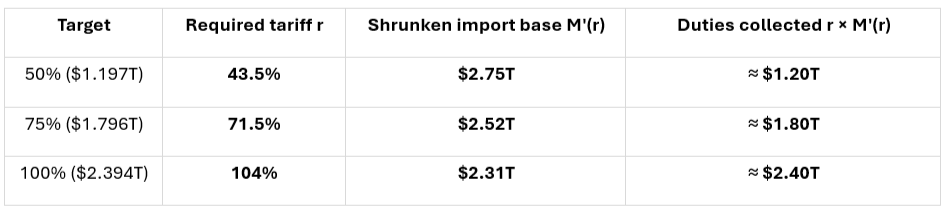
Low Responsiveness
If countries modestly reduce exports, replacing 50% of income tax revenue would require an effective tariff rate closer to 43.5% instead of 36.3%.
Replacing 75% would push rates above 70%, and replacing all of it would require tariff rates exceeding 100%.
Proportional Response
If reductions in imports roughly track increases in tariffs, replacing 50% of income tax revenue would require tariffs around 57.1%.
Replacing 75% pushes rates near 120% and replacing 100% approaches 265%.

High Responsiveness
If countries overreact by 50% proportionate and aggressively reduce imports, even replacing 50% of income tax revenue would require tariff rates north of 100%.
Trying to replace 75%+ of the income tax revenue with tariff revenue, we get the "fun" stuff:
Trade collapses
Prices rise
Supply chains fracture
Consumers, not foreign governments, absorb the cost

Why This Is Political Messaging, Not Policy
When I hear claims that tariff revenue could eliminate income taxes, I don’t hear a serious fiscal plan. I hear political messaging meant to energize a base and/or bring in people on the fence by attacking a topic that is hopefully less popular than the politician mentioning it.
I don’t think President Trump genuinely believes income tax is going away. I think he understands how energizing that idea is for his base and Republicans know it plays well.
That doesn’t make it evil. It's just politics.
And this isn’t meant to be a shot at Republicans. I don’t think Trump is governing meaningfully better or worse than other presidents regardless of whether or not I agree with his policies or actions. Same goes for President Biden before him or President Obama before him. I think Trump is funnier but he’s also far more worried about his own image and that's annoying - like adding his name to the Kennedy Center and his face to the National Parks pass. Biden was calmer, but there wasn't much about is administration that carried real credibility.
Again, the math is still the math.
The Bigger Takeaway
Audacious political claims deserve skepticism, regardless of who makes them and eliminating income tax via tariffs isn’t impossible because we lack imagination. It’s impossible because the numbers simply don’t work.
That doesn’t mean tariffs don’t matter because they certainly do. It also certainly doesn’t mean I'm a fan of income tax or think it's perfect as it is... because it isn’t.
It just means that when politicians promise something that sounds incredible, it’s worth slowing down, grounding the conversation, and asking whether the math actually adds up. In this case, the math doesn't add up, I don't see a scenario where income tax goes away, and... I hope I'm wrong.
Jose Alvarez, CFP®, MBA
Financial Advisor
Founder
Harvest Horizon Wealth Strategies
The information presented in this blog is the opinion of the author and does not reflect the views of any other person or entity unless specified. The author may hold positions in any securities discussed in this blog. The information provided is believed to be reliable and obtained from reliable sources, but no liability is accepted for inaccuracies. This blog should not be interpreted as a full analysis of any particular subject including the subject discussed. Images included in this blog may be created by artificial intelligence. If so, resemblance to any existing persons, past or present, is purely coincidental. The information provided is for informational, entertainment, and educational purposes and should not be construed as advice. Advisory services are offered through Harvest Horizon Wealth Strategies LLC, an investment adviser registered with the state of Wisconsin.


Comments